
Pelayo’s Talent and Development team boosts its growth strategy together with Actua
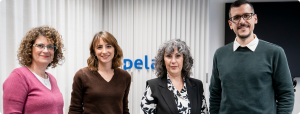
Pelayo has launched Pelayo Campusa new learning ecosystem that redefines the way it trains, accompanies and develops talent. In this interview published in Equipos y Talento, the Talent and Development team shares what the transformation process has been like from the inside.
Actua has had the opportunity to work closely with Pelayo in the creation of a platform that not only responds to operational challenges, but also drives a new learning culture: more intuitive, more connected and aligned with people.
This project reflects how a clear vision, combined with flexible technology and a strategic approach, can translate into real impact for the entire organization.
We invite you to discover how the Pelayo team experienced it, what lessons were learned along the way and what role Actua played as a partner in this change.
Here you can read the full interview.
–
Corporate training has ceased to be a static repository of courses to become a strategic driver of development, engagement and cultural adaptation. Pelayo, one of the leading insurance companies in the Spanish market, after detecting that its previous learning platform was insufficient for its current needs, sought a comprehensive solution that not only modernized the user experience, but also aligned learning with business objectives and performance. The Talent and Development team trusted Actua as a technological and strategic partner to implement Totara, giving life to the new “Pelayo Campus”.
How is training conceived in Pelayo?
Alicia Alameda, Head of Talent and Development at Pelayo (A.A.): We understand training as a continuous accompaniment throughout the entire life of the workforce. It is a constant process that we structure into three main groups of needs. First, the general ones, which include all the mandatory regulatory training, refresher courses and annual renewals required by our sector.
Secondly, those specific to each department. To cover them, we hold meetings to detect needs with each area, which leads to evolutionary, developmental and business adaptation training.
And thirdly, personal needs. Here we want to offer a transversal catalog in which each person can proactively search for the content they want, need or want to do at that moment.
What strategic objectives did you want to achieve with the new training solution?
A.A.: We were looking for a solution that would allow us to manage and develop the talent of our teams, not only from a traditional training perspective, but that would allow us to chart different paths for workforce development.
Pilar Villar, Training Technician at Pelayo (P.V.): We wanted the platform to invite the employee to navigate when he or she enters. We also wanted it to be very flexible, to be able to adapt to the evolution of the company itself and to the needs we might have in the future.
Patricia Campos, Learning Solutions consultant at Actua (P.C.): Pelayo’s Talent team is very creative, eager to work, but the previous platform was limiting them. One of the key points of the project was to integrate their ERP, their HR system, with the new Totara platform. This has greatly streamlined their management: user registrations, cancellations, being able to upload profile information such as position or department… all this flow of automations has allowed them to focus on more valuable tasks.
Why did you choose Actua as your partner?
A.A.: Totara matched our dual pursuit of training and performance, but what made the difference was their approach. They didn’t sell us the product directly, but wanted to meet us first to see how to adapt the tool to our real needs.
In this in-depth diagnosis, what key aspects were analyzed?
A.A.: They analyzed our business model and the training strategy we had. They wanted to meet with different key people to get their direct perception. We went into great depth on the profiles and roles that users had to play on the platform, the membership strategies to be implemented to achieve greater user engagement and, a topic that was critical for us, metrics.
P.V.: Yes, the previous product was too small for us in this respect. We needed a tool with a multitude of reports that would allow us to carry out studies on what is happening with training and, fundamentally, to be able to present results to management. Totara was a perfect fit for this.
What recommendations were particularly relevant to your decision on Totara?
A.A.: A key recommendation from Actua was to go slowly. They explained to us that it was necessary for the organization to get used to the new solution and to generate a different learning culture, and that this process should be gradual.
Were there any key points in the implementation?
A.A.: Maybe the data migration. We migrated the entire file of completed training from the previous platform. In a sector as regulated as ours, the traceability of training is fundamental. In addition, we work very closely with the union representation in the Training Commissions, so it was very important for us to maintain that continuity of information. We did not want users to perceive this as a break, but as a natural evolution.
What was this implementation like for Actua?
P.C.: We sat down with the client and, through various dynamics, we analyzed their current “pains” and their “ideals”, that is, where they would like to be. With all this, we extracted insights, detected opportunities and, together with them, we prioritized and “harvested” what would become the MVP (Minimum Viable Product). That MVP became our compass. Right now we are in “Horizon 1” of the project and we have already defined a “Horizon 2”.
P.V.: They helped us a lot, made it very easy and structured, and the experience of working together was very agile and pleasant.
What role did the internal Talent and Development team play?
A.A.: Our participation was total; we wanted to be there from the very beginning. Our objective was to get to know the tool in depth in order to be autonomous from the beginning. We wanted Actua, in addition to helping and advising us, to give us the knowledge so that, after the launch and implementation phase, we could continue working and developing things on our own.
In addition, as we were very concerned that the change and migration process should be as short and easy as possible for our staff, we paid great attention to meeting deadlines.
What contents and functionalities can your professionals find in Campus Pelayo?
A.A.: “Campus Pelayo” manages all training: online, live virtual and physical (or in the classroom). In addition, we want to evolve it to other spaces such as learning communities or collaborative spaces.
In terms of new developments, one of the biggest differences, and one that is key to our leadership model, is that managers now have the ability to visualize what their team is working on. Giving this visibility to the manager is essential for them to be able to drive the development of their teams.
In terms of content, the experience is totally different. Before, the catalog was dismembered; now we have a single, integrated catalog, grouped by subject. The search is much more logical. We have also incorporated resources and playlists that we did not have before. Campus Pelayo is now a help beyond learning. For example, we have incorporated all the brand resources, corporate images, procedures, templates… We realized that the platform should not only be used for training, but also to enable the employee to do things.
Sergio Villa, Learning Solutions consultant at Actua (S.V.): At Actua, we work on two fronts. First, on centralization, integrating their GoodHabitz catalog, which was previously disconnected. Secondly, we addressed their internal content, on which we carried out a technopedagogical analysis of their training courses. We detected strong points and proposed new methodologies or even specific nuances that helped to enhance the impact.
How have you approached the training paths and the look&feel to optimize adherence?
A.A.: The look&feel is much more attractive, which was one of the objectives. But the key to accessibility and stickiness is in the simplicity of search. Before, employees had to think about what training they wanted to do, then think about where that content might be located, and then search for it. Now, everything is in the same catalog and they simply have to use the filters.
P.V.: The platform allows you to include different categories within the catalog that make locating content much easier. They can search by topic, such as wellness or business development, or filter by duration, for example, courses lasting one hour or more than one hour.
S.V.: We worked directly with their Marketing team to adapt their style book. The goal was to make the environment “as Pelayo as possible”. In addition, this customization is also functional. In the analysis, we defined with their Talent and Development team what was the first thing a user should see when entering. We designed a dashboard that makes available to the employee what is critical and easy to find, to help them through the whole cycle: starting, continuing and finishing their training.
P.C.: To facilitate that first entry, we also created user tours, so that everything would be very guided, very simple, and would really invite the employee to train, which was exactly what was not happening before.
Have you noticed changes in the participation or satisfaction of professionals since implementation? Is there increased engagement?
A.A.: Yes, absolutely. Comparing the data, we have seen that the number of these courses has increased between 40% and 45%. In terms of satisfaction, they are very grateful to us and it is having an important impact.
P.V.: The managers menu, for example, is fundamental. All the new features, such as the simple search or the resource playlists, are very practical and functional.
Speaking of communication, how have you transferred this change to the workforce?
A.A.: We did a launch campaign. We started with a pre-campaign of intrigue (“something is moving”, “something is changing”, “stay tuned to your screen”). When we launched, we used all channels: corporate communications, news, and also physical actions, such as posters in elevators and common spaces. Then, we combined it with individual and segmented communications. We made a specific communication for general users and a different one for the people in charge of the team, explaining them the new visualization functionality they were going to have.
P.V.: In addition, we held live sessions, very short, to which people were free to sign up, where we explained the operation and navigation of the new platform.
They commented that they have strengthened the manager’s role as a driver of development. How does Campus Pelayo help them to get to know their team better and to propose initiatives?
P.C.: We wanted to empower these managers. That’s why one of the keys to the project was to work on a specific dashboard for them. Now they can keep track of what training their team is lacking, what interests they have, when they do it…. It allows them to be much closer to their development.
What lessons would you highlight from the platform change process?
A.A.: The main learning is that you have to get involved. You have to be there from day one. When you are looking for a change like this, you have to have someone to accompany you in the process, a partner to help you and push you to grow. Because the Talent team itself has to grow. You have to learn to do things you didn’t do before and, above all, to think in a different way, and that is a learning process in itself, which is not easy, but it has been very pleasant and very enriching.
Finally, what next steps do you plan to take to further develop training with Actua?
A.A.: We want to grow the platform along several lines. The first is to promote learning communities, which is something that the organization is already demanding. The second clear line is to evolve the strategy of badges that are earned at the end of the courses. Now that we are more mature, we want them to be more meaningful. We want them to help employability and really “open doors”.
Read the full interview here!


